
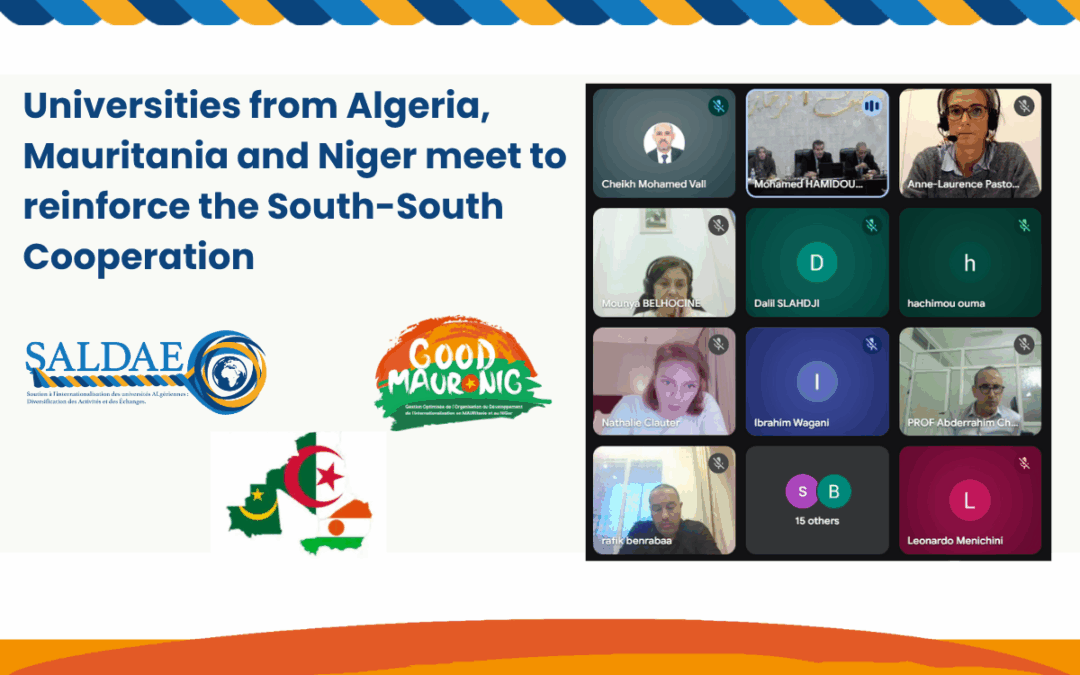
On November 18, 2025, partner Universities of the Good Maur-Nig project held a meeting with partners of the Erasmus+ SALDAE project that work on closely aligned goals in Algeria. Indeed, universities from Algeria, Mauritania and Niger met online to discuss strategies and best practices to strengthen South–South cooperation and advance the internationalisation of higher education.
The meeting, organised with the support of UNIMED, created a space for dialogue, shared learning, and potential development of regional collaboration between the universities by connecting the two consortia and encouraging them to build synergies. The meeting also aimed to bring partners together to join their efforts and increase the impact of their actions under Erasmus+.
Project partners presented the higher education systems of Algeria, Mauritania, and Niger, their governance structures, ongoing internationalisation strategies, and needs of their institution and held an interactive discussion on challenges, opportunities, and perspectives.
Participants shared good practices and expertise adapted to local contexts, and brainstormed on co-developing innovative solutions that respond to the specific challenges faced by universities. They also focused on building strong, autonomous, and lasting academic and institutional networks, and on increasing the visibility and impact of both projects at regional and international levels. Indeed, cooperation between the three countries is not new, developed throughout the years with the hosting of Mauritanian and Nigerien students in Algerian universities. Yet, joint research remains limited, even though the countries share many priorities and strategic themes, such as green hydrogen, offering promising opportunities for future collaboration.
The SALDAE project, coordinated by the University of Béjaia, aims to strengthen institutional capacities in the field of internationalization of Algerian universities through the transfer of know-how, management capacities and best practices for the proper functioning of the international cooperation service.
Both projects aim to strengthen the capacity of Higher Education Institutions to engage in international cooperation. Bringing the consortia together for the first time provided an opportunity to exchange practices, discuss shared challenges, and explore practical synergies. The universities also agreed to explore all potential avenues for collaboration, including joint fundraising initiatives. They explored how universities from the three countries can work more closely together, especially through exchange visits, mobility programmes, and framework agreements to formalise long-term cooperation. The meeting demonstrated how joint efforts can reinforce impact at institutional, national, and regional levels, while supporting a broader South–South cooperation agenda.